Client
Imperial College London
Year
2026
Brief
Design a digital app that helps patient with non-adherence in CPAP therapy.
Keywords
User research, Digital product design, Strategy, Health tech
Designing CPAP Buddy
We've spent a few years now designing for behaviour change in healthcare, with SloMo, Aura, and now CPAP Buddy.
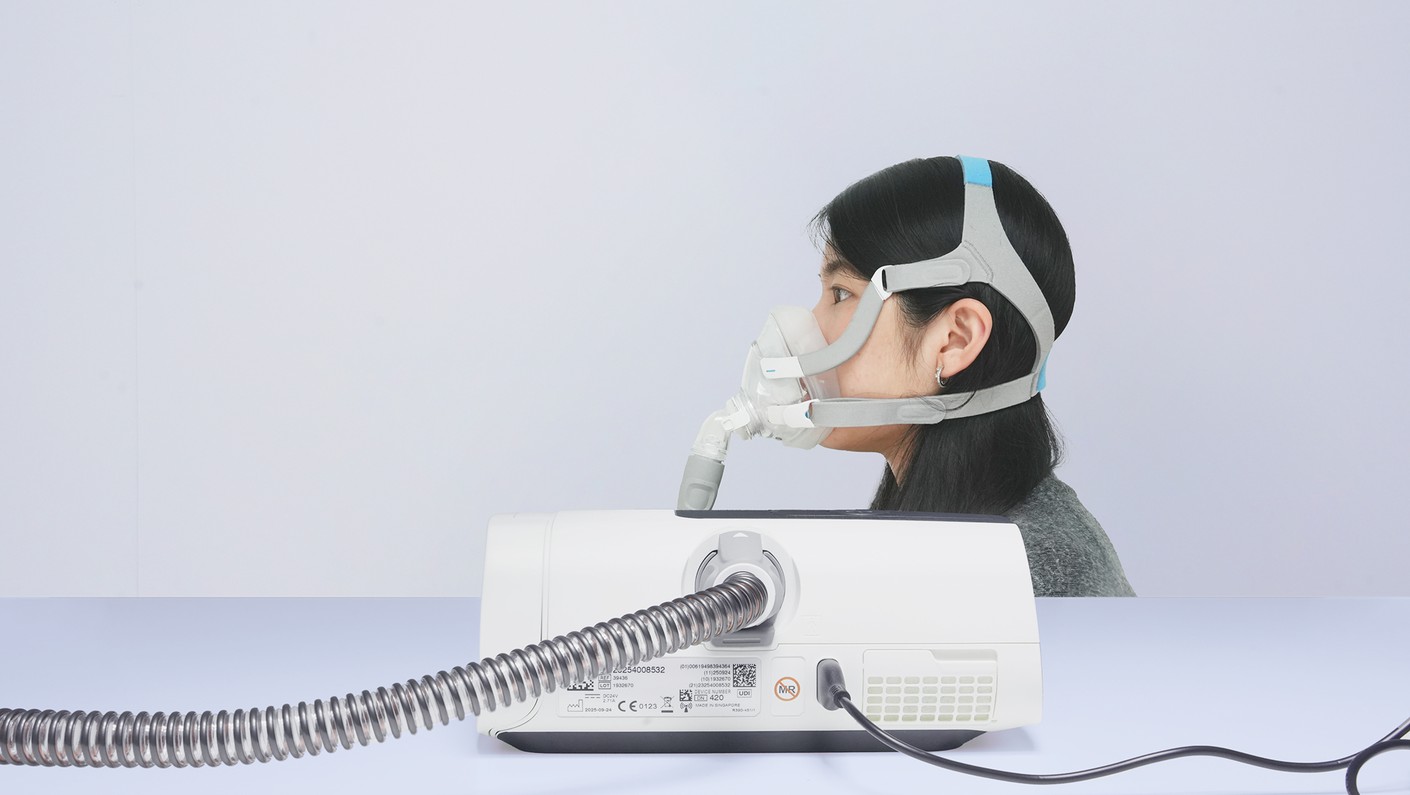
In 2026, we partnered with Dr Amanda Sathyapala and her team at Imperial College London's National Heart and Lung Institute to look at a stubborn problem in respiratory medicine. Dr Sathyapala's own research found that 62% of people prescribed CPAP therapy for obstructive sleep apnoea weren't using it enough, just three months after starting, to get any real health benefit from it. Not because the treatment doesn't work – it's one of the most effective therapies in sleep medicine – but because living with it, every night, is hard.
The project, backed by £2.2 million from the UK's Medical Research Council and CPAP manufacturer Fisher & Paykel, recently featured in Wired's coverage of the wider shift in sleep apnoea treatment.
In 2026, we partnered with Dr Amanda Sathyapala and her team at Imperial College London's National Heart and Lung Institute to look at a stubborn problem in respiratory medicine. Dr Sathyapala's own research found that 62% of people prescribed CPAP therapy for obstructive sleep apnoea weren't using it enough, just three months after starting, to get any real health benefit from it. Not because the treatment doesn't work – it's one of the most effective therapies in sleep medicine – but because living with it, every night, is hard.
The project, backed by £2.2 million from the UK's Medical Research Council and CPAP manufacturer Fisher & Paykel, recently featured in Wired's coverage of the wider shift in sleep apnoea treatment.
"Special Projects did a superb job designing the CPAP Buddy app — far surpassing my expectations, even given their reputation as a multi-award-winning agency. What impressed me most was their commitment to understanding the problem before jumping to solutions: they spoke to patients directly, and even tried CPAP themselves. Every meeting was collaborative, productive, and genuinely enjoyable, and I look forward to continuing to work with them."
Dr. Amanda Sathyapala
Associate Professor in the Airways Disease Section of the National Heart and Lung Institute of Imperial College London
Associate Professor in the Airways Disease Section of the National Heart and Lung Institute of Imperial College London
We set out to ask a different question:
What if the thing standing between someone and a treatment that works isn't willpower, but the language, relationships and everyday logistics wrapped around it?
Before designing anything, we spent six weeks trying to understand what non-adherence actually feels like from the inside. We went through the same mask-fitting session every NHS patient goes through, then took a machine home to sleep with ourselves. We spoke with people who'd used CPAP for over twenty years and people who'd just been diagnosed, people who'd given up and come back, across a wide range of ages and backgrounds. Then, we brought in outside specialists most sleep-tech projects wouldn't think to call: a behavioural scientist who works with elite athletes, a consumer technology journalist, and a psychosexual and relationship therapist.
That last expert might raise a few eyebrows, but ultimately sleep apnoea affects couples, families, careers and confidence long before it shows up in clinical outcomes. It seemed strange to design for the medicine without designing for the relationship around it.
Imperial had already done the groundwork to get here. Large-scale patient surveys and focus groups had shaped a behavioural intervention, tested and approved by patients, built around improving motivation to use CPAP. Our research set out to add to that foundation, not replace it. After all, motivation is only one part of adherence; alongside the everyday opportunity and capability someone needs to actually use the machine, night after night.
Three themes ran through everything we found, each one adding a different layer to the intervention Imperial had already built.
Practical. Adherence often breaks down over small, solvable things – a mask that leaves marks before the school run, not knowing if a machine can go through airport security, not realising there's a different mask shape that might actually fit. People weren't giving up on the treatment, they were giving up on working around it alone.
Psychological. The people who stuck with CPAP longest weren't the most disciplined, but the ones who stopped seeing it as fixing something broken and started seeing it as investing in themselves. That shift from "I have a medical problem" to "I'm looking after myself" mattered more than any reminder or streak.
Relational. The machine doesn't just sit between a person and their airway. It sits between a person and whoever shares their bed. We spent real time exploring how a partner can go from finding the machine intrusive to treating it as an ally, and how families explain an alarming-looking piece of medical equipment to children without frightening them.
CPAP Buddy is a medical device, which means it's still working through the testing and certification that any product making health claims has to go through, so we can't share what we've actually built yet. What we can say is that none of this was ever about getting people to comply. It's about giving people the motivation, opportunity and capability to make CPAP work for their life, building on the insight Imperial's own research had already surfaced, and going further into the practical and relational conditions that sit alongside it.
Group testing begins later this year. We'll share more as we're able to.
Before designing anything, we spent six weeks trying to understand what non-adherence actually feels like from the inside. We went through the same mask-fitting session every NHS patient goes through, then took a machine home to sleep with ourselves. We spoke with people who'd used CPAP for over twenty years and people who'd just been diagnosed, people who'd given up and come back, across a wide range of ages and backgrounds. Then, we brought in outside specialists most sleep-tech projects wouldn't think to call: a behavioural scientist who works with elite athletes, a consumer technology journalist, and a psychosexual and relationship therapist.
That last expert might raise a few eyebrows, but ultimately sleep apnoea affects couples, families, careers and confidence long before it shows up in clinical outcomes. It seemed strange to design for the medicine without designing for the relationship around it.
Imperial had already done the groundwork to get here. Large-scale patient surveys and focus groups had shaped a behavioural intervention, tested and approved by patients, built around improving motivation to use CPAP. Our research set out to add to that foundation, not replace it. After all, motivation is only one part of adherence; alongside the everyday opportunity and capability someone needs to actually use the machine, night after night.
Three themes ran through everything we found, each one adding a different layer to the intervention Imperial had already built.
CPAP Buddy is a medical device, which means it's still working through the testing and certification that any product making health claims has to go through, so we can't share what we've actually built yet. What we can say is that none of this was ever about getting people to comply. It's about giving people the motivation, opportunity and capability to make CPAP work for their life, building on the insight Imperial's own research had already surfaced, and going further into the practical and relational conditions that sit alongside it.
Group testing begins later this year. We'll share more as we're able to.